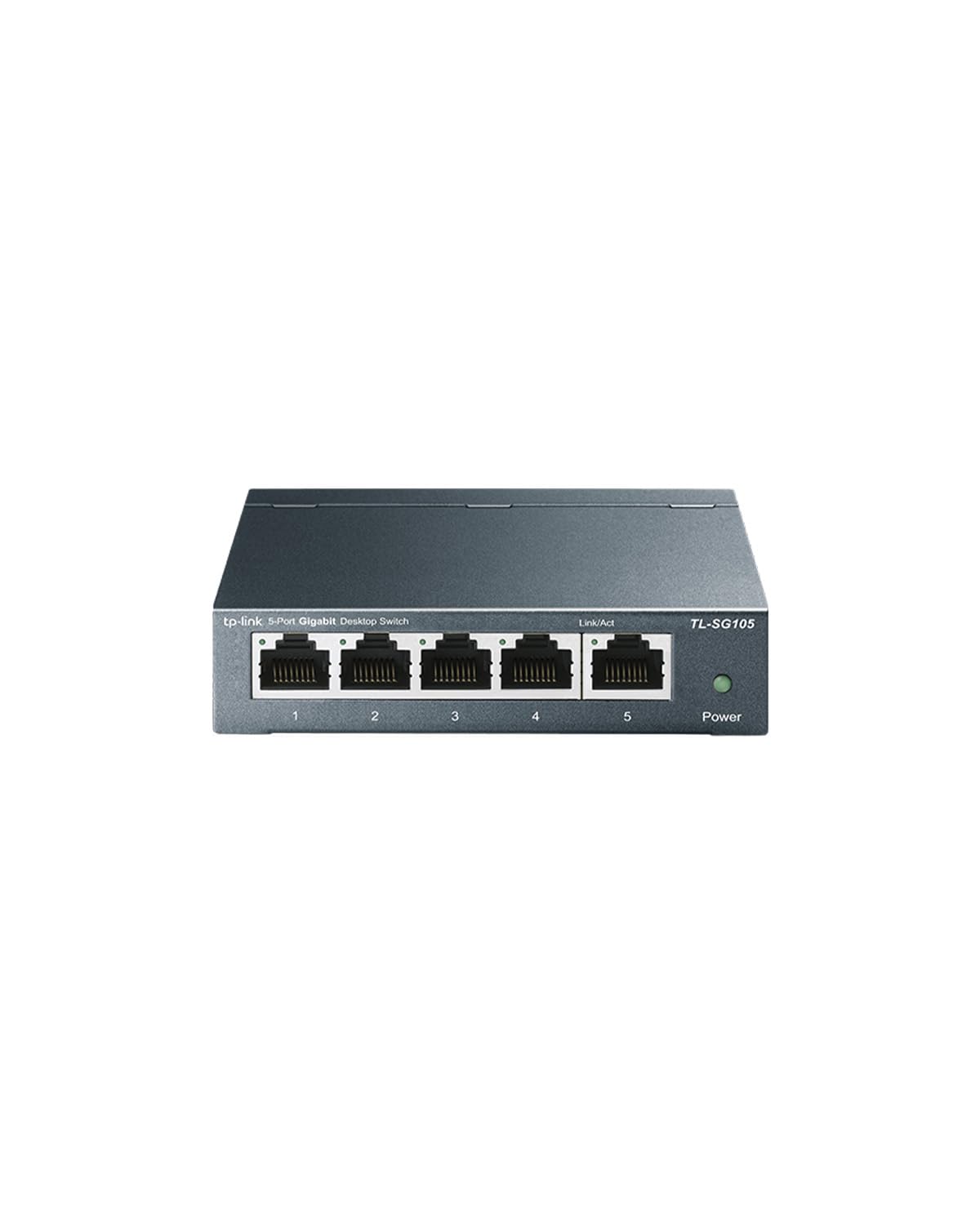
This tp link tl sg105 switch review looks at a compact way to add wired Ethernet connections where a router or network gateway does not have enough ports.
Five Gigabit ports, plug-and-play setup, and a fanless metal case make it a straightforward option for homes and small offices.
TP-Link TL-SG105 Review Summary
The quick verdict
130,000+ ratings
Read Amazon ReviewsTP-Link TL-SG105
A compact, fanless switch for home or small-office users who need five wired Gigabit Ethernet connections without setup complexity.
- Five 10/100/1000 Mbps RJ45 ports with auto-negotiation and Auto MDI/MDIX.
- Unmanaged, plug-and-play operation that does not require software installation or configuration.
- IEEE 802.3X flow control for data transfer management.
- Port-based 802.1p/DSCP QoS and IGMP Snooping for traffic prioritization and multicast handling.

Pros
- Adds five wired Gigabit connections in a small footprint.
- Simple setup suits buyers who want to expand an existing network without managing switch settings.
Consider before buying
- Five ports may be limiting if several devices need wired connections; count the uplink and every device before choosing.
- Its unmanaged design is intended for straightforward expansion, so buyers needing configurable network controls should check that requirement before purchase.
Read the full review summary
The TL-SG105 is a five-port unmanaged switch with 10/100/1000 Mbps RJ45 connections, auto-negotiation, and Auto MDI/MDIX.
Connect it to an existing network and it can provide additional wired ports without software installation or configuration, keeping setup simple for everyday devices.
Its metal case, fanless design, desktop or wall-mounting options, and traffic features give it flexibility beyond the bare minimum.
QoS support and IGMP Snooping may be useful on networks carrying voice, video, or multicast traffic, though this switch is still an unmanaged model rather than a tool for configuring a complex network.
The buying factors
TP-Link TL-SG105 Scorecard
Editorial scores reflect listed features and buyer fit; they are not laboratory measurements or customer ratings.
Port count for small networks
Five Gigabit Ethernet ports offer a practical expansion point for a handful of wired devices.
Ease of setup
Plug-and-play operation requires no software installation or configuration.
Gigabit connectivity
All five RJ45 ports support 10/100/1000 Mbps with auto-negotiation.
Noise-conscious placement
The fanless design supports quiet operation in a desk or living space.
Traffic handling features
Port-based 802.1p/DSCP QoS and IGMP Snooping add useful traffic features for a simple switch.
Mounting flexibility
Desktop and wall-mounting designs accommodate more than one placement style.
Key Features and Specifications of TP-Link TL-SG105
- Five 10/100/1000 Mbps RJ45 ports with auto-negotiation and Auto MDI/MDIX.
- Unmanaged, plug-and-play operation that does not require software installation or configuration.
- IEEE 802.3X flow control for data transfer management.
- Port-based 802.1p/DSCP QoS and IGMP Snooping for traffic prioritization and multicast handling.
- Fanless metal casing designed for quiet desktop use and wall mounting.
- Compact enclosure measuring approximately 3.94 × 3.85 × 0.98 inches.
Pros and Cons of TP-Link TL-SG105
Pros
- Adds five wired Gigabit connections in a small footprint.
- Simple setup suits buyers who want to expand an existing network without managing switch settings.
- Fanless construction avoids fan noise during normal operation.
- Metal case and desktop or wall-mounting design offer useful placement choices.
- QoS and IGMP Snooping provide additional traffic-handling features for certain network uses.
Consider before buying
- Five ports may be limiting if several devices need wired connections; count the uplink and every device before choosing.
- Its unmanaged design is intended for straightforward expansion, so buyers needing configurable network controls should check that requirement before purchase.
- The listed feature set does not describe Power over Ethernet; buyers planning to power devices through Ethernet should confirm their power requirements and select compatible equipment.
Who Should Buy TP-Link TL-SG105?
Good fit
Consider the TL-SG105 if your router, gateway, or existing switch is short on wired connections and you need a simple way to add a small group of Gigabit Ethernet ports.
Its five-port layout is suited to a desk, media area, or compact office setup where devices can connect by cable and manual switch configuration is not part of the plan.
The fanless metal design and flexible desktop or wall-mounting placement also make it a reasonable fit for a shared room or workspace where quiet operation matters.
QoS and IGMP Snooping may be useful when the network carries voice or video traffic, while the plug-and-play approach keeps setup approachable for users who do not want to manage an additional network interface.
Before buying, map the connections you need, including the link back to your router or existing network. If the total exceeds five ports, or a connected device must receive power over Ethernet, choose equipment that matches those needs.
Who should skip it
Skip this model if you need a larger port count, a managed switch with configurable network controls, or Ethernet-based power for connected devices. Check those requirements against the switch and the rest of your network before ordering.
How the TP-Link TL-SG105 fits a small wired network
Five ports and the real connection count
The five-port count is the central buying constraint.
One connection normally links the switch to the existing network, leaving the remaining ports for local devices, so buyers should count their planned connections rather than treating all five as device-only ports.
This makes the model most practical when only a modest number of wired connections need adding.
Gigabit links for mixed devices
Each port supports 10/100/1000 Mbps and auto-negotiation, allowing the switch to connect with devices that use different supported Ethernet link rates.
The aggregate data-transfer figure in the specifications should not be read as a guarantee of end-to-end internet speed: the actual connection depends on the network, its devices, and the service feeding it.
Unmanaged simplicity and traffic features
Plug-and-play setup reduces the steps needed to expand an existing network, while the unmanaged design keeps the device focused on basic connectivity.
QoS and IGMP Snooping add traffic-related functions, but buyers who need to set detailed network policies should first confirm that an unmanaged switch fits their plan.
Quiet placement and enclosure
A fanless design is a useful fit for rooms where equipment noise would be distracting.
The metal enclosure and desktop or wall-mounting design make placement flexible; check that the chosen location has room for the switch, its connected cables, and its power adapter.
Alternatives to TP-Link TL-SG105
No alternative model is recommended here. Compare the port count, management features, and power requirements that matter to your network before choosing another switch.
Is TP-Link TL-SG105 Worth It?
The TP-Link TL-SG105 is worth considering when you need a small, quiet, uncomplicated way to add wired Gigabit connections to an existing network.
Its five ports, plug-and-play setup, metal enclosure, and traffic features suit homes and compact offices that do not need switch configuration.
Count the connections you need and check whether any devices require Ethernet power before choosing it.
If five ports and unmanaged operation match your setup, it offers a focused solution; buyers needing more ports or configurable controls should look for a switch designed around those requirements.
Your review at a glance
130,000+ ratings
Read Amazon ReviewsTP-Link TL-SG105
A compact, fanless switch for home or small-office users who need five wired Gigabit Ethernet connections without setup complexity.
- Five 10/100/1000 Mbps RJ45 ports with auto-negotiation and Auto MDI/MDIX.
- Unmanaged, plug-and-play operation that does not require software installation or configuration.
- IEEE 802.3X flow control for data transfer management.
- Port-based 802.1p/DSCP QoS and IGMP Snooping for traffic prioritization and multicast handling.